Mental health support for busy rec teams
Your recreation, sport and leisure staff work odd hours across gyms, pools and clubs. Give them fast, confidential access to Australian psychologists, with the reporting you need.
Make an Enquiry
We work with clubs and leisure venues






A young, casual workforce carries a heavier mental health load than most
of people aged 16 to 24 had a mental disorder in the past year, the highest of any age group and the age band that dominates the recreation workforce
of arts and recreation workers are aged 15 to 24, far younger than most industries
of arts and recreation workers are part-time, and around one in five are self-employed, pointing to fragmented, irregular hours
An EAP that fits how recreation actually works
Your people don't sit at desks from nine to five. They open the pool before dawn, run weekend programs, lead tours through the school holidays and pack down events late at night. A standard, office-shaped EAP doesn't reach them. Talked is built to fit shift work, seasonal peaks and a workforce where many staff are young and early in their careers.
One in five Australians aged 16 to 85, or 4.3 million people, had a mental disorder in the past year, with anxiety the most common condition.
In August 2023, 2.7 million employees, around 22% of all employees, had no entitlement to paid leave, leaving casual recreation workers exposed to lost income when poor mental health keeps them away.
The median time off work for a serious mental health claim is 35.7 working weeks, almost five times longer than the median across all serious claims.
Fast, high quality care your young team will actually use
More than a third of people aged 16 to 24 experienced a mental disorder in the past year, and that age group makes up a large slice of the recreation workforce. For many of your staff, this is the first job where mental health support is even on offer, so it needs to be easy to reach and genuinely good.
Talked connects your people with registered psychologists and counsellors in days, not weeks, with no waitlists. Sessions run by video or phone outside standard hours, so a lifeguard, instructor or events crew member can book around their roster instead of around ours.
Talk to an expert
Cover staff that casual rosters usually leave behind
Almost half of arts and recreation workers are part-time and around one in five are self-employed, which means fragmented hours and patchy support. Many casual staff have no entitlement to paid leave, so a tough patch with their mental health can quickly turn into lost income and a lost team member.
- Every worker is covered the same way, whether they are full-time, casual, seasonal or a contracted instructor
- Booking takes minutes and works around split shifts, weekend work and school-holiday peaks
- Support reaches staff across multiple sites, mobile programs and outdoor locations, not just head office

Meet your duty of care and see it working
Psychosocial hazard obligations apply to recreation just like every other industry, and a serious mental health claim keeps someone off work for a median of 35.7 weeks, almost five times longer than other serious claims. Getting in early protects your people and your roster.
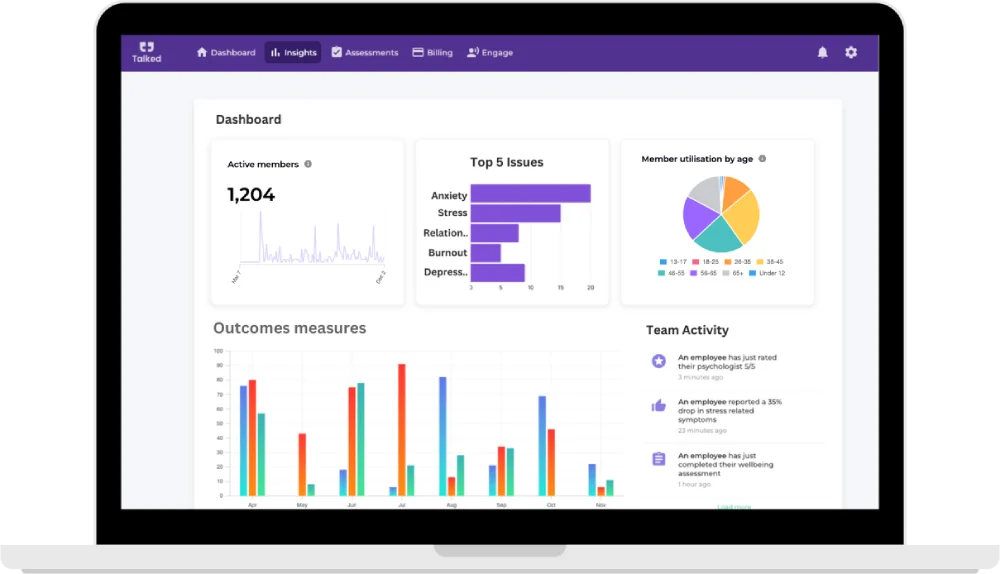
Talked gives you clear, de-identified reporting on usage, themes and outcomes, so you can show your board, insurer or regulator that real support is in place and being used. You get the evidence without ever seeing who booked what.
What recreation employers ask us
Yes, when access is easy it gets used. The recreation workforce skews young, with around 25% of arts and recreation workers aged 15 to 24, and people aged 16 to 24 have the highest rate of mental disorders of any age group at 38.8% in the past year. That means the need is real and present in your team. Talked is built for fast, low-friction access by phone or video outside standard hours, so your staff can reach a clinician without taking time off a shift or sitting on a waitlist. We also give you simple materials to promote it across sites, noticeboards and rosters so your people know it is there.
Every session your staff have with a Talked psychologist or counsellor is private. As the employer you never see who booked, what they discussed or any clinical detail. What you do receive is de-identified reporting that shows how many people are using the service, the broad themes coming up across your workforce and the outcomes being achieved. That gives you what you need to show your duty of care is being met and to plan ahead, while your team can reach out with complete confidence.
Yes. Almost half of arts and recreation workers are part-time and around one in five are self-employed, so we designed Talked for exactly this kind of mix. Your full-time managers, casual lifeguards, seasonal program staff and contracted instructors can all access the same high quality support, wherever they are based. Booking works around split shifts and weekend rosters, and there is nothing for a worker to set up in advance, so a new starter taken on for the summer is covered from day one.
Australian work health and safety duties now expect employers to manage psychosocial hazards, and recreation is no exception given long hours, public-facing roles and irregular work. Talked gives your people fast access to qualified clinical support, which is a practical part of managing those risks. Just as important, our de-identified reporting gives you documented evidence that support is available, promoted and used, which helps you demonstrate compliance to your board, insurer or a regulator if asked.
The cost of doing nothing is high. One in five Australians aged 16 to 85 had a mental disorder in the past year, and the median time off work for a serious mental health claim is 35.7 working weeks, almost five times longer than the median across all serious claims. In a sector that relies on people being present, energetic and good with the public, one prevented breakdown or one retained experienced staff member can outweigh the cost of the program. Talked focuses on early, effective care and measurable outcomes so you can see what the program delivers.
Quickly. There is no long implementation project. We set your organisation up, give you ready-to-use launch materials for your sites and channels, and your staff can start booking high quality clinical support straight away with no waitlists. Because access is by phone and video, it works the same for a single venue or a network of pools, gyms, clubs and program sites across the state.
How Talked supports your people
References
- Australian Bureau of Statistics (ABS), National Study of Mental Health and Wellbeing, 2020-2022 (latest release)
- Australian Bureau of Statistics (ABS), Working Arrangements, August 2023
- Jobs and Skills Australia, Arts and Recreation Services industry profile (2024)
- Safe Work Australia, Key Work Health and Safety Statistics 2024
- PwC and Beyond Blue, Creating a Mentally Healthy Workplace: Return on Investment Analysis (2014)
- Productivity Commission, Mental Health Inquiry Report (2020)
Figures reflect publicly reported Australian data and are indicative. Talked is not affiliated with the organisations listed.
Give your recreation team mental health support that fits their world



Talked acknowledges the Traditional Owners of the lands on which we operate and pays respect to Elders past, present, and emerging.
We welcome and respect people of all backgrounds, genders, sexualities, abilities, and cultures.
If you are in crisis or experiencing suicidal or homicidal thoughts, please contact 000 or access these resources for emergency assistance.

Get the Talked App